Agents spend on their own
A single workflow fans out into hundreds of model calls. Agents retry, loop, and escalate to bigger models, without any human approval from the FinOps team.
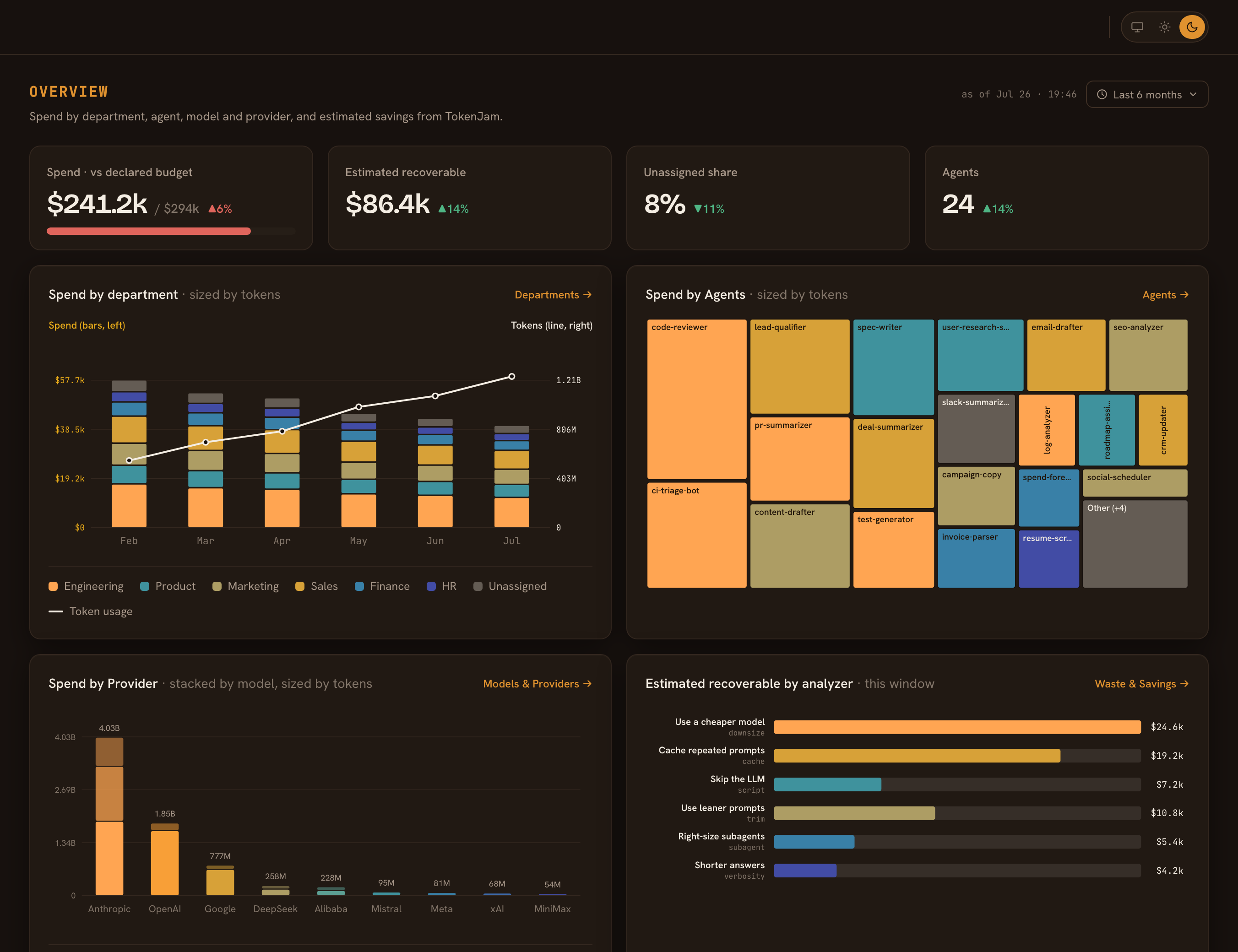
See every dollar your team spends on AI, broken down by department, agent, developer, pull request, model and provider. Find ways to reduce token spend and tie AI spend to value delivered.



Works with your agent stack
A single workflow fans out into hundreds of model calls. Agents retry, loop, and escalate to bigger models, without any human approval from the FinOps team.
Anthropic, OpenAI, Google, AWS, and the rest each send their own invoice. There is no shared ledger, so no one owns the total.
There are a dozen ways to cut the bill: cheaper models, cached prefixes, leaner prompts, scripts. Knowing which to pull, where, and when is a full-time job no one has.
The invoice tells you the number. It cannot tell you which of last quarter’s merged PRs that number produced, or how much went into sessions that shipped nothing. That is the question the budget conversation actually turns on.
TokenJam is the ledger that ties AI spend to the work it produced and strives to make sure tokens are being used as efficiently as they can be.
TokenJam prices each call as your agents make it and rolls it up the way your org is actually shaped: department, agent, developer, model, repo. Subscription-covered usage is separated from API-billed usage, so a Claude Max seat never renders as a surprise invoice. The drill-down behind every figure goes to the request.
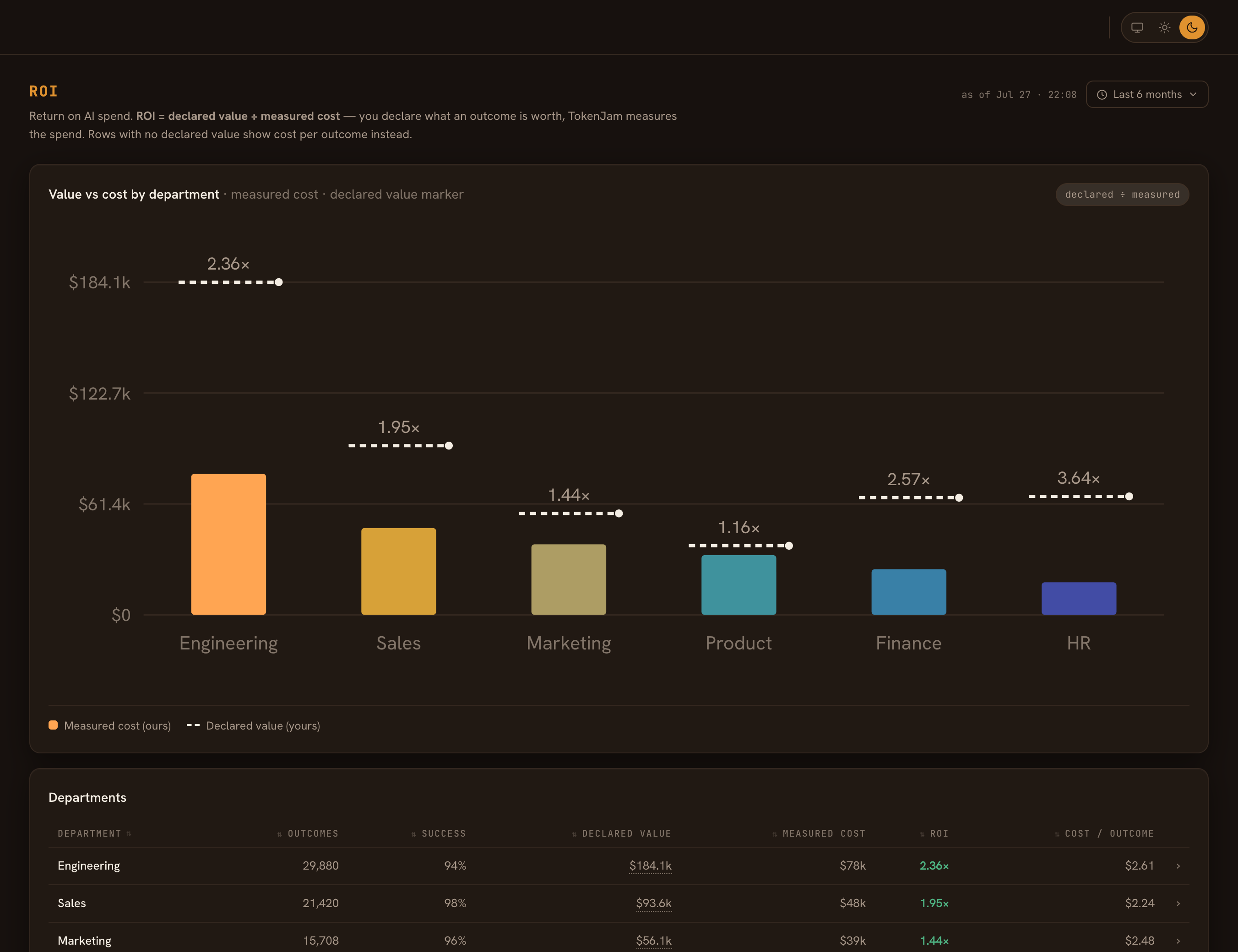
For coding agents, TokenJam matches sessions to the commits and merged pull requests that came out of them, against your own git history. For the rest of your fleet you name the outcome that counts and declare what one is worth. Either way you get cost per outcome, the share of the work that was AI-assisted, and the spend that went into sessions which produced nothing. That last number is the one that starts the conversation.
Analyzers run across the fleet and put a dollar figure on each opportunity: cheaper routes, cacheable prefixes, repeated work, prompts carrying more than they need, deterministic tool calls better run as a script, answers longer than anyone reads. Each finding names the agent and the department it came from.
Set a monthly ceiling per provider and watch the run-rate against it. Accepted findings become draft policies that sit in a queue with the dollars they are expected to return. Nothing takes effect until someone approves it, and the approval is recorded.
Attribute goes first. The moment an agent makes a call, TokenJam prices it and files it under the department, agent, developer and model that spent it. Measure picks up that priced history and joins it to your merge queue. Spend never shows up without a cost per merged PR beside it. Optimize reads the same history from the other end, hunting for money you can get back and ranking it by how much. Accept one. Enforce writes it up as a draft policy with a declared ceiling and parks it for someone on your team to sign off. Then the next window of spend lands, and Attribute starts over.
Create an account and onboard your team in minutes or grab us for a 30min demo. Zero cost to start and no credit card needed.
For large and regulated orgs with data-residency and compliance needs: self-hosted and airgapped deployments run the same engine in your own network. Your telemetry never leaves.
A FinOps tool reconciles provider invoices after the month closes. It sees the number and nothing underneath it. TokenJam sits on the telemetry your agents already emit, prices every call as it happens, and matches the session to the commit it produced. So the answer stops being "$40k on Anthropic" and becomes "$163 per merged PR at 55% coverage, with $21.4k in sessions that shipped nothing." Then it ranks the recoverable waste inside that spend.
Yes. Attribution is provider-agnostic: every call lands in the same org, department, agent, and model hierarchy regardless of who billed it. You get one ledger across all of your providers.
Not on its own. Enforce is two things today: budget ceilings you declare per provider with the run-rate against them, and a queue of proposed changes built from the findings, each carrying the dollars it is expected to return. Nothing takes effect until someone on your team approves it, and the approval is recorded. Every optimization is checked against your own sessions before you switch.
No. The GitHub App is read-only and needs no code change at all. For per-call cost, the tj CLI reads the transcripts Claude Code and Codex already write, including the ones from before you installed it. Custom agents send OpenTelemetry with standard gen_ai semantics, so there is no proprietary SDK to add.
Then run it inside. The same engine deploys self-hosted or fully airgapped in your own network. See TokenJam Enterprise for the deployment and compliance detail.
No. Developers are pseudonymous ids by default, per-developer views are admin-only, there is no rank column anywhere, and per-developer figures stay hidden until at least five developers are present. An org can turn names on. It cannot turn ranking on, because we do not build it.
No. Sessions are stamped with the plan they ran on, and subscription-covered usage is reported separately from API-billed usage rather than priced as if you had paid list. TokenJam never proxies or forwards subscription credentials.