Why AI Bills Keep Rising While Token Prices Fall
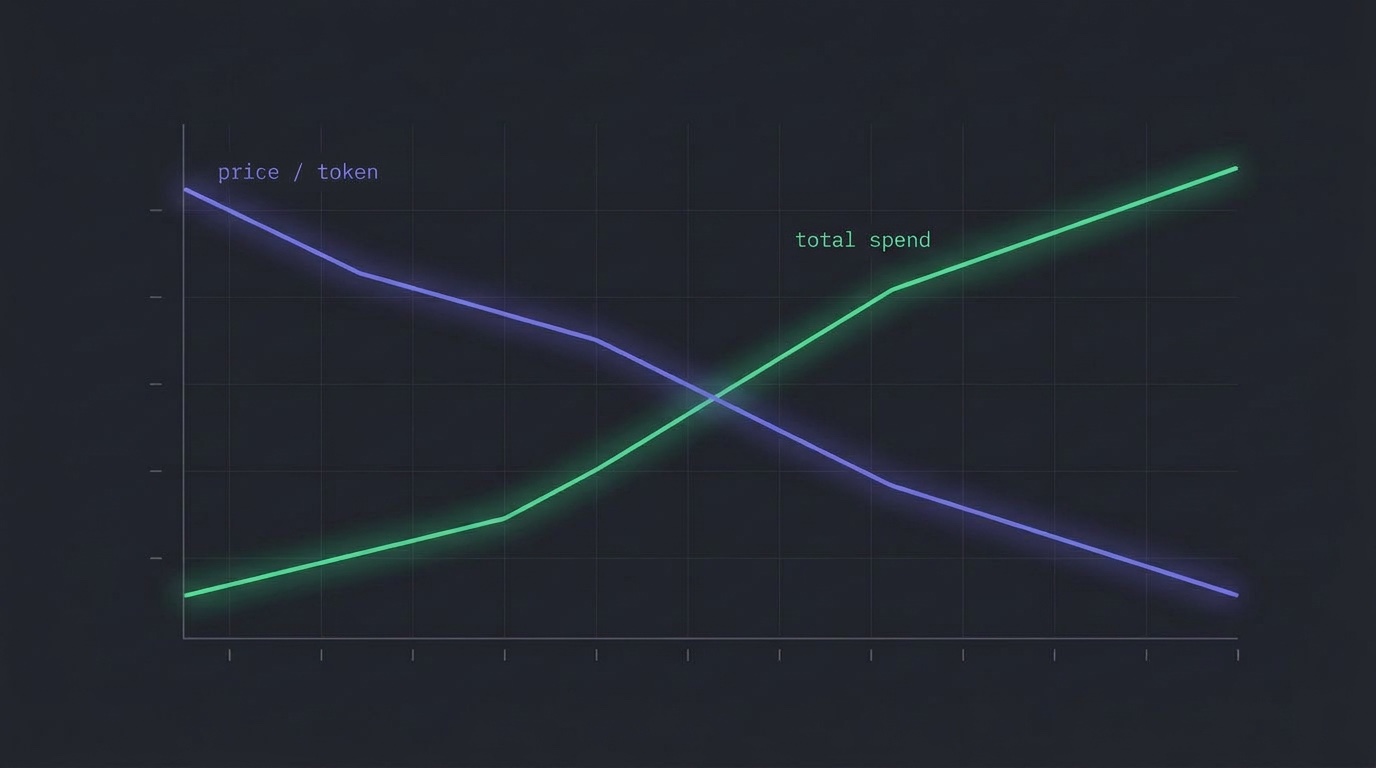
Two numbers from the past year look like they contradict each other.
In February 2025, Sam Altman wrote that “the cost to use a given level of AI falls about 10x every 12 months, and lower prices lead to much more use.” He was not exaggerating the drop. A million GPT-4 tokens in early 2023 cost roughly 150 times what the equivalent GPT-4o call cost by mid-2024.
Then look at the aggregate. Gartner forecasts worldwide AI spending at about $2.59 trillion in 2026, a 47% jump on the year before. Prices per token fell hard, and the total bill still climbed.
If your own AI costs keep growing while every vendor announces another price cut, you are not misreading your invoice. You are watching a 160-year-old economic pattern play out on your token usage.
Why do AI bills go up when token prices go down?
Because a lower price per token changes behavior. When each call is cheap, teams make more calls, feed in more context, run more agents, and let those agents loop longer. The extra volume outruns the price cut, so the total goes up even as each unit gets cheaper.
The clearest version of this came from Altman’s own sentence: lower prices lead to much more use. That second half is where the bill lives. A 10x price drop that triggers a 30x jump in usage is a 3x larger bill, and it will still be reported everywhere as “AI got 10x cheaper.”
Where do all the extra tokens come from?
The consumption growth is not evenly spread. A few specific behaviors account for most of it, and each one scales quietly.
Longer context is the largest. Agents re-send their history on every turn, so a conversation that ran fine at 5,000 tokens of context in turn one can be paying for 80,000 tokens of re-sent history by turn twenty. The FinOps community now flags re-sent context as one of the single biggest hidden line items in production AI.
Agent fan-out multiplies the count. One request that spawns a planner and six sub-agents is seven models running where a script used to run once. Retries add another layer. A failed tool call that loops three times bills three times.
None of this is waste by definition. Some long contexts and some sub-agents earn their tokens. The point is that a falling price per token hides all of it. The unit got cheaper, so nobody notices the count going up.
What actually lowers your AI bill?
Not the next price cut. If your spend rises with cheaper tokens, the lever that moves your number is consumption, and consumption is measurable on your own runs.
The honest version of this has three plain steps. Record what your agents actually do. Find the tokens that repeat with no new value, like history re-sent every turn or a plan re-derived on every identical run. Cut those, and leave the tokens that are doing real work alone.
That is the whole idea behind TokenJam. It reads your recorded agent runs locally and shows where the tokens went, so a decision to switch models or trim context is made against your own numbers instead of a vendor’s headline. You can watch it work on a synthetic run with tj demo before pointing it at anything real.
A cheaper model can help. It helps a lot more once you know which part of your bill is doing work and which part is just the price cut inviting you to spend more.
- Is the Jevons paradox actually happening with AI, or is that just a metaphor?
- Both halves are measured. OpenAI reports the cost of a fixed level of capability falling about 10x per year, and Gartner forecasts total AI spending rising to roughly $2.59 trillion in 2026, up 47% year over year. Price per unit down, total spend up, is the exact shape Jevons described for coal in 1865. The mechanism is the same: cheaper access drives usage up faster than price falls.
- If prices keep dropping, won't my bill eventually fall on its own?
- Only if your consumption stops growing, and so far it has grown faster than prices have dropped. Your bill is price per token multiplied by tokens used. Vendors move the first number. You move the second. Waiting for a price cut hands the one controllable variable to your own usage patterns.
- What is the single biggest driver of rising token consumption?
- Re-sent context. Most agent frameworks resend the full conversation history on every turn, so input tokens climb turn over turn even when the new instruction is short. A twenty-turn session can spend most of its input budget re-reading its own earlier turns. Prompt caching and context trimming target this directly.
- How do I see where my own tokens are going?
- Install with `pipx install tokenjam` (or `pip install tokenjam`), run `tj onboard` to start recording your sessions, then `tj optimize` to see the breakdown. It works on your own recorded runs, locally, so the numbers are yours rather than an industry average. Try `tj demo` first if you want to see the output before instrumenting a real agent.
Install with pipx install tokenjam to see where your own token bill is going.