AI Budget Overruns: Why Agentic Spend Is So Hard to Forecast
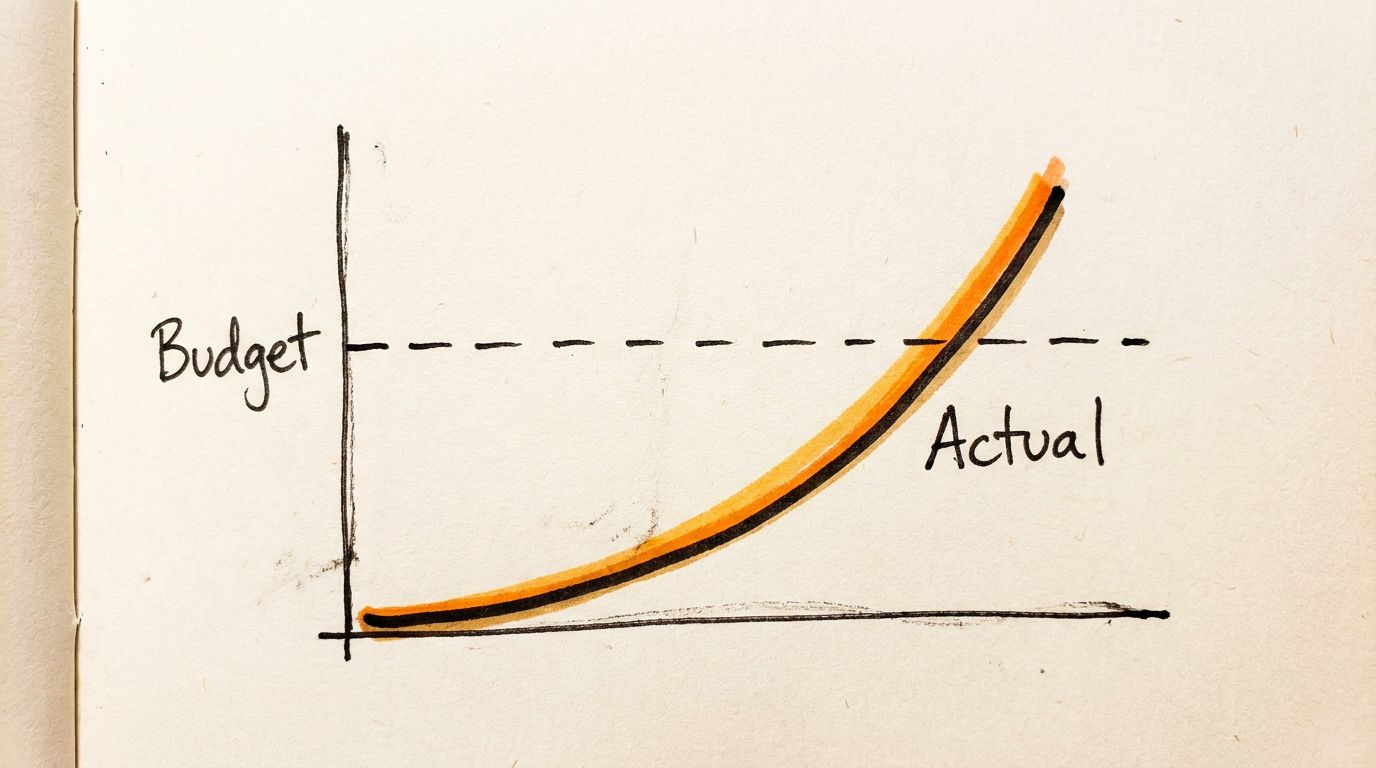
Someone approved an AI budget last quarter. It was a real number, argued for in a planning meeting, built from a price per token and a guess at how many calls the team would make. Then the agents shipped, and the bill did something the spreadsheet had not planned for. This is the base case now. A 2026 review of 127 enterprise agentic deployments found that 73% went over budget, and some blew past their original estimate by more than 2.4 times.
Why do AI budgets keep getting overshot?
AI budgets get overshot because they are priced on a single-call mental model while the workload underneath is agentic. One user request can expand into a planner and several sub-agents, each making its own model calls, so the token count finance signed off on was never the token count that ran.
The numbers line up across sources. A February 2026 survey of 500 enterprises put AI cost overruns at 79% over the prior year. The agentic-specific review of 127 deployments found 73% over budget, some past 2.4 times their plan. And the people holding the bill are increasingly FinOps teams: 98% of them manage AI spend today, up from 63% in 2025 and 31% in 2024, per the FinOps Foundation’s 2026 State of FinOps report. That is the fastest any category has been folded into FinOps in the survey’s six-year history. The accountability moved faster than the tooling to meet it.
Why is agentic spend so hard to forecast?
Agentic spend is hard to forecast because the agent decides how much to spend while it runs. A forecast needs a stable unit of work to multiply out. An agent does not hand you one.
A few behaviors do most of the damage, and each scales quietly. Fan-out is the loudest. One request that spawns a planner and six sub-agents is seven models running where a script used to run once, and the plan counted a single call. Retries stack on top of that. A tool call that fails and loops three times bills three times, and the estimate reserved nothing for it. Re-sent context is the slow leak. Most agent frameworks resend the full conversation history on every turn, so a session that cost 5,000 input tokens on turn one can be paying for 80,000 tokens of re-read history by turn twenty. The FinOps community flags re-sent context as one of the largest hidden line items in production AI.
What does honest AI cost forecasting look like?
Honest AI cost forecasting starts by measuring what you already spend, then projecting that rate forward with the assumptions written down. You cannot predict what an autonomous agent will do next week. You can measure what it did this week and price the run-rate.
TokenJam’s Lens dashboard shows a run-rate: your daily spend projected to the end of the current billing cycle. It carries the label “not a forecast” on purpose. The number is a straight line, daily rate times days remaining, with no seasonality or anomaly modeling bolted on, because that dressing would make a guess look like a prediction. A per-provider projection then compares that pace against a ceiling you set, and attribution breaks the spend down by agent and feature so you can see which slice is moving the total. None of this stops an overrun. It removes the surprise. A budget you can watch against a live run-rate is one you can act on before the cycle closes, rather than reading about it on the invoice.
The backdrop makes all of this sharper. Per-token prices keep falling, which reads as relief and quietly invites more usage, so the total bill climbs anyway. We wrote about that pattern in why AI bills rise as token prices fall. A forecast that ignores the consumption side will keep missing, no matter how cheap the unit gets.
You can see your own run-rate locally. Install with pipx install tokenjam, run tj onboard to record your sessions, then tj optimize to see where the spend concentrates.
- How common are AI budget overruns in 2026?
- Common enough to be the base case. A 2026 review of 127 enterprise agentic deployments found 73% over budget, some past 2.4 times their estimate, and a February 2026 survey of 500 enterprises put overruns at 79% over the prior year. On the accountability side, the FinOps Foundation reports 98% of FinOps teams now manage AI spend, up from 31% in 2024.
- Why can't I forecast agent spend the way I forecast cloud spend?
- Cloud spend maps to resources you provision and control. Agent spend maps to token counts the agent decides at runtime through fan-out, retries, and re-sent context. The unit of work is not stable, so a projection built on last month's average misses the moment a workflow starts spawning more sub-agents per request.
- Does a hard budget cap fix AI overruns?
- A cap helps as a backstop. A cap that auto-downgrades a model or cuts off work with no human in the loop trades a cost surprise for a reliability surprise, which is often the worse one. The safer pattern is a visible run-rate plus an alert well before the ceiling, so a person decides what to change. A cap on a model whose price you never recorded also does nothing, since the spend was never attributed to it.
- How do I see my own AI run-rate?
- Install with `pipx install tokenjam` (or `pip install tokenjam`), run `tj onboard` to start recording, then open the Lens dashboard for the run-rate and `tj optimize` for the breakdown. The numbers come from your own recorded sessions, locally, so they reflect your workload rather than an industry average. Try `tj demo` first if you want to see the output before instrumenting a real agent.
Install with pipx install tokenjam to watch your AI spend against a live run-rate.