Measuring AI Agent ROI: You Need the Cost Side First
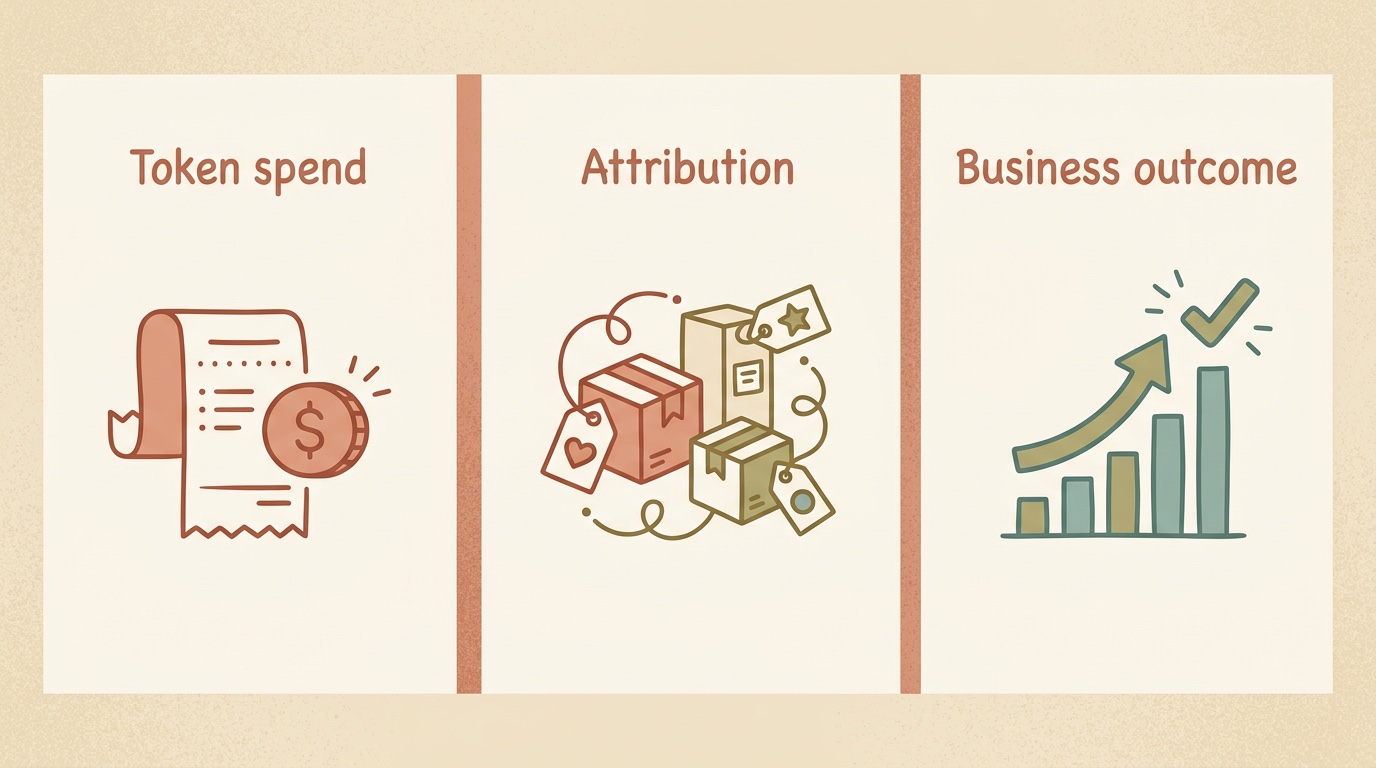
Every board deck in 2026 has an AI ROI slide. Most of them are guessing.
Gartner reports that only about one in five AI investments shows a measurable return. In one survey, 44% of executives said generative AI is the hardest type of AI to measure the return on. MIT’s widely-cited study found that the large majority of enterprise generative-AI pilots showed no measurable impact on the P&L within their first six months. Meanwhile 61% of leaders say they feel more pressure to prove AI returns than they did a year ago, and almost all of them plan to spend more next year anyway.
That combination, rising spend and unprovable returns, is not a measurement mystery. It is arithmetic with a missing number.
Why is AI agent ROI so hard to measure?
ROI is a fraction. Return on investment is the value an initiative created divided by what it cost. Both halves have to be real numbers or the result is a story.
Most teams can describe the value in words. The agent closed more tickets. The workflow shipped a week sooner. What they can rarely produce is the cost of that specific outcome. The invoice from the model provider is one blended figure for the whole account, mixing every feature, team, and experiment that ran that month. Divide a described benefit by a number you had to estimate and you have a slide, not a measurement.
Agents make the denominator harder, not easier. A single agent request can fan out into a planner and several sub-agents, re-send its whole history on every turn, and retry a failed step three times. The tokens pile up in ways that no per-seat license or flat subscription reflects. So the cost of the outcome you are proud of is buried inside a bill that never names it.
What does “connecting spend to outcomes” actually require?
The FinOps community frames the value of AI as six domains: employee productivity, revenue growth, cost efficiency, customer experience, operational resilience, and competitive advantage. Those are yours to define and measure. Nobody outside your business knows what a resolved support ticket or a shipped feature is worth to you.
What connects that value to a real cost is attribution. To put a spend figure next to an outcome, the spend has to be recorded against the thing that produced it: the feature, the tenant, the team, the individual agent. That is the number a blended bill throws away and the number an honest ROI fraction needs.
The shift is visible in the data. According to the FinOps Foundation, 98% of FinOps teams now manage AI spend, up from 31% two years ago. Cost governance for AI went from a niche to a default in the time it took agents to reach production. The teams doing it well are the ones who can answer a plain question: for this outcome, what did we spend, and on what.
The honest version of measuring ROI
A tool cannot tell you what your customer experience is worth. That figure lives in your business, and any product that claims to compute your returns for you is selling you the numerator you were supposed to own.
What a tool can do is make the cost side exact. That is the whole design of TokenJam. It records per-call telemetry from your agents locally and attributes spend down to the dimensions you care about, so the denominator under your ROI fraction is a measured number instead of a monthly average. Its SDK carries attribution fields like tenant and feature so a call’s cost lands against the work it did. Once the spend is attributed, the same data shows you which of it was avoidable, which is the fastest way to move the ratio without touching the value at all.
Prove the value in your own terms. Measure the cost in real ones. Then the ROI slide stops being a story.
- How do you actually calculate AI agent ROI?
- Take the business value the agent produced over a period and divide it by what it cost to run over the same period. The value is defined by your business (revenue, hours saved, tickets resolved). The cost is the tokens, tool calls, and infrastructure the agent consumed, ideally attributed to that specific agent or feature rather than read off a blended account bill. The measurement stands or falls on how real the cost figure is.
- Why can't I just use my monthly model provider bill?
- A provider invoice is one number for the whole account. It mixes every feature, team, and experiment that ran that month, so it cannot tell you what any single outcome cost. Dividing a specific benefit by an account-wide average produces a figure that looks exact and is really an estimate. You need spend attributed to the feature or agent to put a true number in the denominator.
- What is cost attribution for AI agents?
- Attribution records each unit of spend against the thing that caused it: a tenant, a product feature, a team, or an individual agent. Instead of one bill, you get spend broken down by the dimensions that map to your outcomes, so you can place a real cost next to the value each one produced. It is the input an honest ROI calculation needs and the input a blended bill discards.
- How do I start measuring my agents' cost per outcome?
- Install with `pipx install tokenjam` (or `pip install tokenjam`), run `tj onboard` to start recording your agent sessions, then `tj cost --group-by agent` to see spend broken out. If you build on the SDK, tag calls with attribution fields like tenant and feature so cost lands against the work. It reads your own recorded runs locally, so the figures are yours rather than an industry average.
Install with pipx install tokenjam to attribute your agents’ spend down to the feature that earned it.